Renovation and expansion of the National Library of Bern
Facts and Figures
- __
Client
Federal Office for Buildings and Logistics (BBL)
- __
Construction Cost
CHF 237.5
- __
Location
Bern, Switzerland.
- __
Participants
Federal Office for Buildings and Logistics (BBL)
ARGE-GP NatBib
Christ & Gantenbein AG
Drees & Sommer Schweiz AG
MetaXD as overall BIM coordination
The document also mentions coordination with specialists such as fire protection, building physics, and heritage preservation.
- __
Project Contract Value
CHF 315000
- __
Reference Customer Name
Herr Julian Kommer
- __
Time Frame
2024–2033
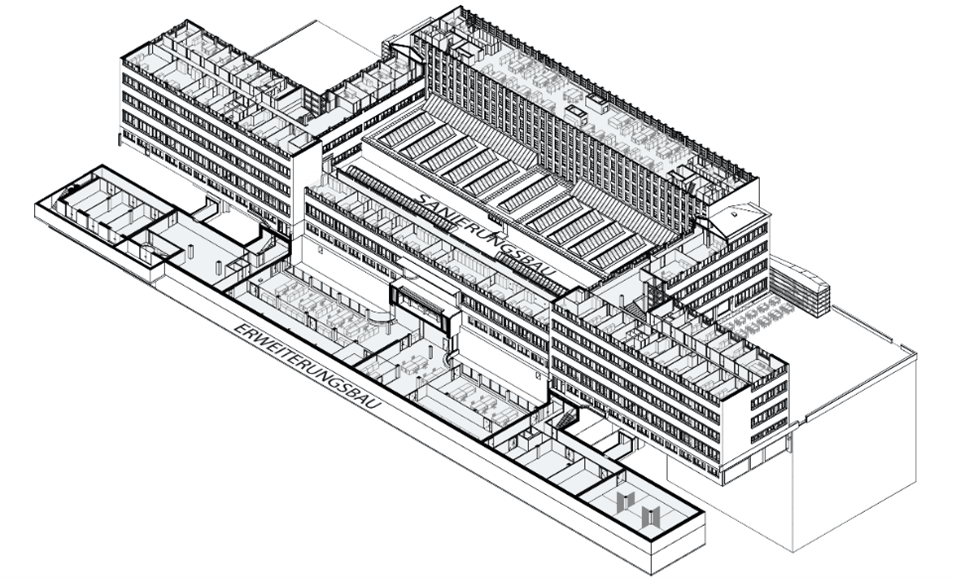
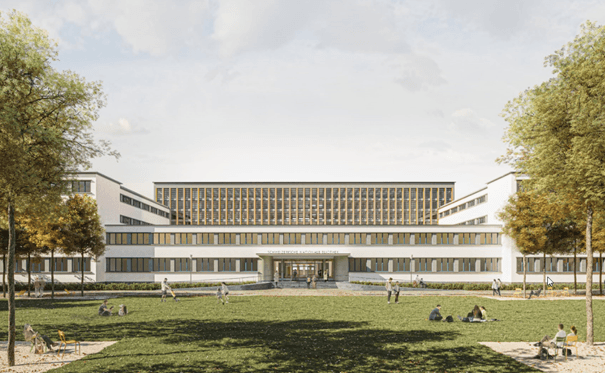
The renovation and extension of the Swiss National Library in Bern is far more than a conventional construction project. It represents the evolution of an architecturally significant heritage building into a contemporary cultural and knowledge destination — a transformation that demands architectural sensitivity, technical precision, and a high level of digital coordination. Guided by the vision of a “Forum”, the project aims to reshape the traditional library into a modern, publicly accessible place for exchange, learning, and culture.
The starting point is exceptionally complex. The existing building, dating back to 1931 and considered an important example of Neues Bauen, is being comprehensively renovated under strict heritage protection requirements. This includes the structural strengthening of the building, particularly the iconic book tower, the renewal of building services, and the adaptation of spatial layouts to meet contemporary needs. At the same time, the project includes the construction of a highly demanding underground extension in the groundwater zone, which will be linked to the existing building through light wells. In addition, the existing underground storage facilities in the east and west wings are being technically upgraded and modernised.
In a project of this scale and complexity, carefully structured digital coordination becomes essential. This is where MetaXD takes on a central role: as the overall BIM coordinator for the ARGE-GP NatBib consortium. In this key function, MetaXD acts as the interface between the BIM management team of the general planner and the BIM discipline coordinators across the various trades. The objective is to ensure the cross-disciplinary implementation of BIM goals while maintaining data quality and consistency throughout the entire planning and construction process.
The scope of services extends well beyond traditional model coordination. Core responsibilities include the setup, development, and administration of the Common Data Environment (CDE) in Revizto, the overall coordination of all discipline models, and close collaboration with the BIM specialists of all project authors involved. In addition, MetaXD provides training and support to project stakeholders, particularly in the area of information checking using IDS. In this way, BIM is not treated simply as a planning methodology, but as a collaborative framework that connects all participants.

A major component of the work lies in ongoing model coordination and quality assurance. Discipline models are brought together regularly into an overall coordination model and checked through automated processes for both geometric and informational compatibility. At the same time, the models are continuously reviewed for geometry, alphanumeric data quality, and compliance with BBL data guidelines and the required element plan. This systematic quality control provides a reliable basis for decision-making in both planning and execution.
MetaXD also plays a defining role in shaping project processes. This includes the preparation and facilitation of the biweekly Digital Coordination Meetings (DKS), including meeting minutes and open-task management. The team also contributes to the phase-based development of the BIM Execution Plan (BEP) and prepares BIM status reports and quality assurance reports. With the preparation of BIM2Field processes, the project further bridges the gap between digital planning, on-site construction, and future as-built documentation.
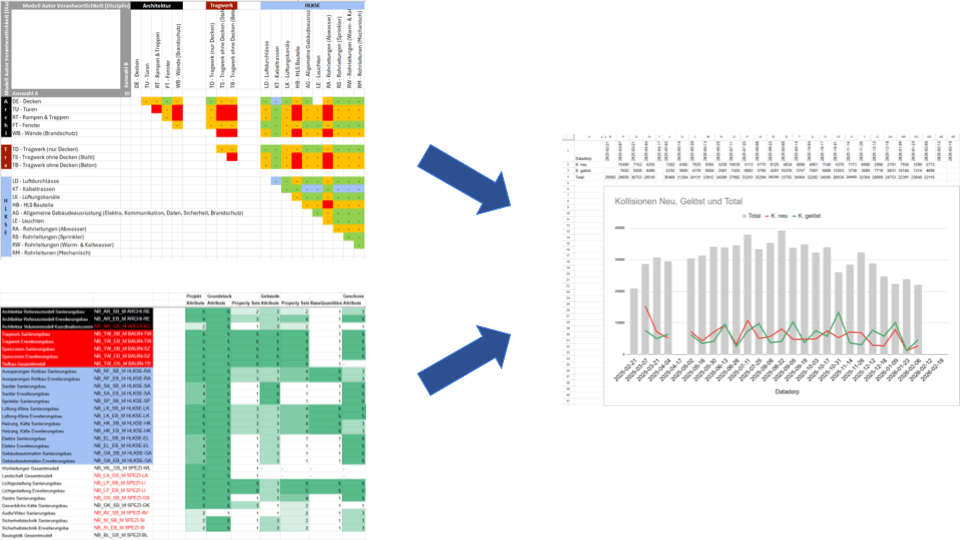
What makes this project particularly remarkable is its high level of complexity. Coordination takes place at the intersection of advanced building technology — including strict climate categories for the protection of cultural assets — and the sensitive historical fabric of the existing book tower. At the same time, the project requires close collaboration with a wide range of specialists, including experts in fire protection, building physics, and heritage conservation, some of whom do not work with their own BIM models and instead contribute information directly via databases. In such an interdisciplinary setting, the value of strong BIM coordination becomes especially clear.
The use of Revizto as a cloud-based collaboration platform further strengthens this process. It enables efficient issue tracking, direct connections to authoring systems, and transparent collaboration across all disciplines. As a result, individual contributions are brought together into one coherent, coordinated picture — an essential condition for a project that must balance heritage preservation, new construction, technical performance, and long-term operational needs.
The renovation and extension of the Swiss National Library in Bern therefore stands not only as an architecturally and culturally significant undertaking, but also as a strong example of how digital coordination can redefine the delivery of complex heritage and infrastructure projects. It demonstrates how historical substance, modern engineering, and BIM-based collaboration can be brought together into one forward-looking vision.
